
Your mate down the road reckons he can build you a website for $500. Meanwhile, that fancy agency wants $15,000 for what looks like the same thing.
So what's the real cost? And more importantly, why does the answer sound like "how long is a piece of string?"
Here's the uncomfortable truth: most business owners are asking the wrong question. You're focused on what a website costs when you should be asking what a website that doesn't convert is costing you.
Key Takeaways
- Website costs in Australia range from $500 (DIY/template) to $100,000+ (enterprise custom builds), but price alone tells you nothing about value.
- The real cost of a cheap website isn't the upfront price, it's the thousands in lost conversions, wasted ad spend, and eventual rebuilds.
- Most website pricing is based on hours invested, but what you're actually paying for is expertise, strategy, and the ability to turn visitors into customers.
- Lead generation websites typically range from $2,000 to $30,000+ depending on complexity, while eCommerce sites start at $6,000 and can exceed $100,000.
- The three critical factors that determine actual value: conversion optimisation, SEO foundations, and ongoing performance, none of which show up in "cheap" quotes.
- AI-powered tools are changing the landscape, letting you build functional sites quickly, but you still need to know what makes a website convert.

Website Cost Estimator
Get a ballpark estimate for your project — takes 60 seconds
Why Website Pricing in Australia Is So Confusing
When it comes to websites, most business owners are completely lost. And I don't blame you.
You've got no reference point for what's fair. One freelancer quotes $2,000, another agency wants $20,000, and some bloke on Fiverr will do it for the cost of a decent lunch. They all show you portfolios that look roughly the same to your untrained eye.
So you do what any rational person would do: you focus on the one thing you can compare. Price.
Here's why that's a terrible idea.
Unless you've built high-converting websites before, you can't tell the difference between a website that makes you money and one that burns it. To the average business owner, they look identical. Same modern design, same contact forms, same "professional" feel.
The Real Cost of a Cheap Website
The difference is invisible until you start spending money driving traffic to it. That's when you discover your $2,000 website converts at 0.8%, while your competitor's $12,000 site converts at 4.2%. Suddenly that "expensive" website is printing money while yours is a black hole.
I've watched this play out dozens of times. Business owner goes cheap, launches their site, starts running Google Ads or Facebook campaigns. The clicks come in. The form submissions don't.
So they increase the budget. Still nothing. They try different ads. They "optimise" their targeting. They blame the platform, the algorithm, the market. Everything except the real problem.
Your website isn't converting because it was built by someone who has no idea what makes visitors take action. They know how to install WordPress and pick a nice colour scheme. They don't understand persuasive copy, trust signals, objection handling, or the psychology of conversion.
Key Insight
The actual cost of a cheap website isn't the price tag. It's every visitor who bounces, every form that doesn't convert, every month you wait to rebuild, and the eventual rebuild that costs twice as much because you're starting from scratch.
I've seen businesses spend $30,000 on ads driving traffic to a $1,500 website that converts at 1%. That same business with a properly built site converting at 4% would have generated an extra $87,000 in revenue from the exact same ad spend.
Which website was actually expensive?
What You're Actually Paying For (Hourly Rates Breakdown)
Most web designers charge based on time. Fair enough. They estimate how many hours the project will take, multiply by their hourly rate, add some margin for risk, and give you a quote.
Here's what determines those hours and rates.
Web Designer and Developer Hourly Rates in Australia
Australian web professionals typically charge between $50 to $250 per hour. The massive range comes down to experience, specialisation, and what they actually deliver.
| Rate Range | Experience Level | What You Get |
|---|---|---|
| $50 to $80/hr | Junior developers and designers | Template-based builds, minimal customisation, limited SEO understanding |
| $100 to $150/hr | Mid-level professionals | Custom design work, basic SEO, some conversion knowledge, decent results |
| $150 to $250/hr | Senior specialists | Deep user psychology, integrated SEO strategy, performance optimisation, revenue-generating track records |
Now here's the thing nobody tells you: the hourly rate matters far less than what you're actually buying.
A $250/hour specialist who builds a website in 30 hours ($7,500) that converts at 4% is infinitely cheaper than a $75/hour generalist who takes 40 hours ($3,000) to build a site that converts at 0.8%.
How Agencies Spend Your Website Budget
Let's say you're quoted $10,000 for a website. Most agencies run on 10 to 30% profit margins, so let's use 20% for this example.
That leaves $8,000 for your actual project. If the average blended hourly rate is $125 (mixing junior and senior resources), you're getting roughly 64 hours of attention.
Here's how those hours typically break down:
| Phase | Hours | What You're Getting |
|---|---|---|
| Discovery and Strategy | 8 to 12 | Understanding your business, competitors, target customers, and what drives conversions |
| Design | 12 to 16 | Custom layouts, UX planning, mobile optimisation, brand integration |
| Development | 20 to 25 | Coding, CMS setup, performance optimisation, responsive implementation |
| Content and SEO | 8 to 12 | On-page optimisation, meta tags, site structure, conversion-focused copy |
| Testing and Launch | 4 to 6 | QA, cross-browser testing, performance checks, launch support |
| Project Management | 8 to 10 | Coordination, client communication, timeline management |
The problem with budget websites isn't just fewer hours. It's which hours get cut. Most cheap providers axe discovery, strategy, and conversion optimisation. You know, the bits that actually make the website work.
Website Cost Estimator
Get a ballpark estimate for your project — takes 60 seconds
Lead Generation Website Costs: $2,000 to $30,000+
These are service businesses, professional services, local businesses, anything where the website's job is to generate enquiries, phone calls, or bookings.
| Price Range | What You Get | Who It's For |
|---|---|---|
| $500 to $2,000 | DIY builder or template with minimal customisation. No strategy, no custom design. | Absolute startups with zero budget. Expect to rebuild within 12 months. |
| $2,000 to $5,000 | Template-based with some customisation, 5 to 8 pages, basic SEO, stock photos. | Small businesses wanting a basic presence. Will struggle with paid traffic. |
| $5,000 to $10,000 | Custom design, 8 to 12 pages, proper SEO, decent UX, professional photos, conversion-focused structure. | Established businesses serious about growth. The sweet spot for most SMEs. |
| $10,000 to $20,000 | Fully custom design and dev, comprehensive SEO, CRO, professional copywriting, advanced features. | Businesses where the website is a primary revenue driver. ROI typically justified in 3 to 6 months. |
| $20,000 to $30,000+ | Strategic positioning, extensive user research, advanced functionality, CRM integration, ongoing optimisation. | Competitive markets where conversion rate directly impacts profitability. |
The jump from $5k to $10k typically includes professional copywriting, advanced SEO strategy, and conversion rate optimisation. Those three things have the biggest impact on results.
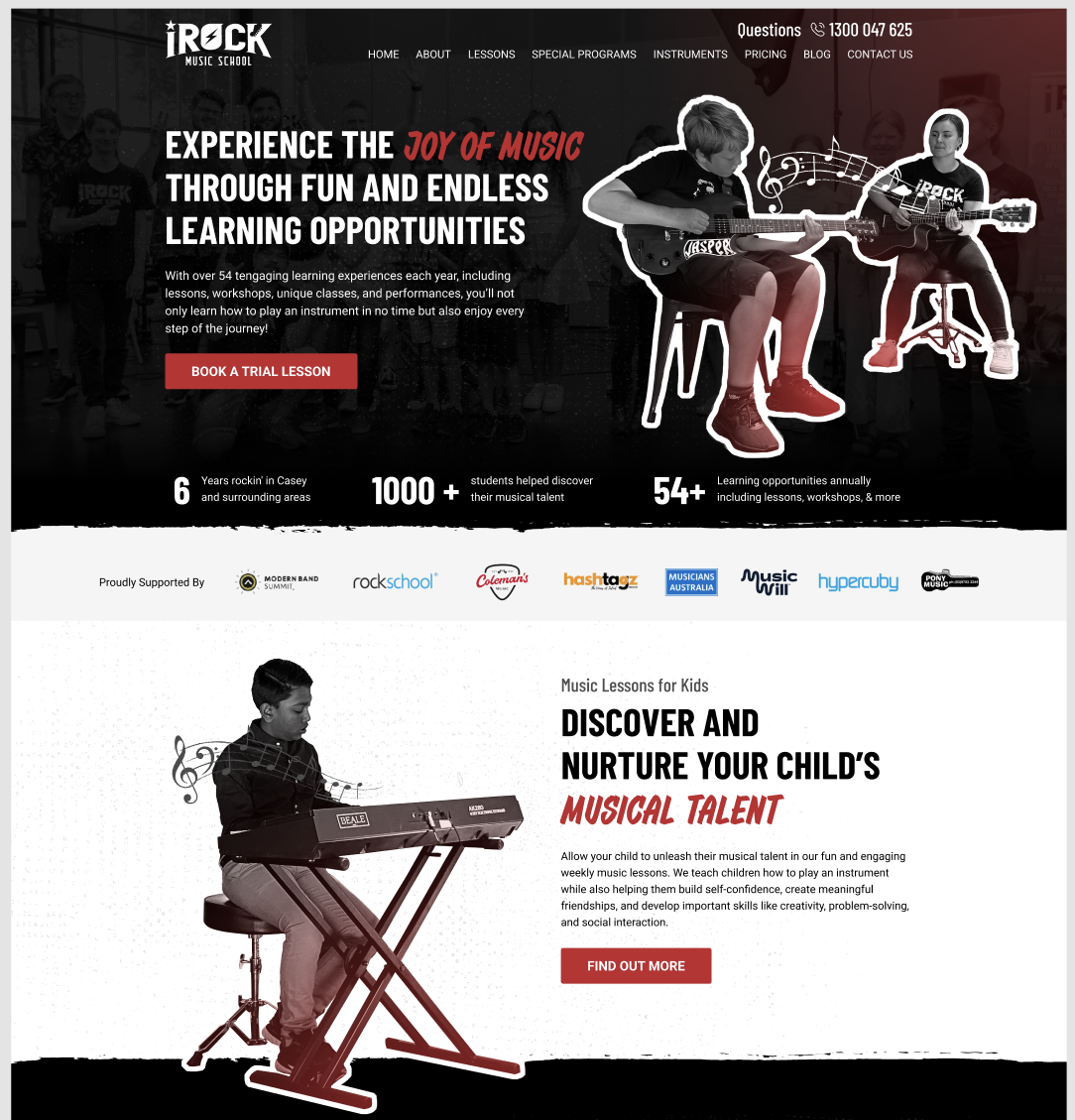
Here's an example of a lead generation website we built for a music school that drives consistent student enquiries:
eCommerce Website Costs in Australia: $6,000 to $100,000+
Online stores are a completely different beast. The complexity scales quickly based on product count, features, and integration requirements.
| Price Range | What You Get | Platform | Who It's For |
|---|---|---|---|
| $0 to $1,000 | DIY setup, template theme, manual product upload, basic payments | Shopify, Squarespace | Testing product-market fit. Not sustainable for serious retail. |
| $6,000 to $12,000 | Professional setup, customised template, product photography guidance, payment integration | Shopify | Small to medium retailers launching online. Good starting point. |
| $12,000 to $25,000 | Custom theme design, comprehensive product setup, advanced filtering, upsells, email integration | Shopify, WooCommerce | Established retailers moving online or scaling. |
| $25,000 to $50,000 | Fully custom design and dev, advanced features (size guides, AR), complex integrations, international shipping | Shopify Plus, WooCommerce | Serious eCommerce businesses doing $500k+ annually. |
| $50,000 to $100,000+ | Enterprise-level, custom features, extensive integrations, headless commerce, PWA | Shopify Plus, Magento, Custom | Multi-million dollar retailers with complex requirements. |
Here's what most people don't realise about eCommerce: the platform matters less than the implementation. I've seen Shopify stores generating $5M annually that started with a template. I've also seen $80,000 custom Magento builds that flopped because the business fundamentals weren't there.
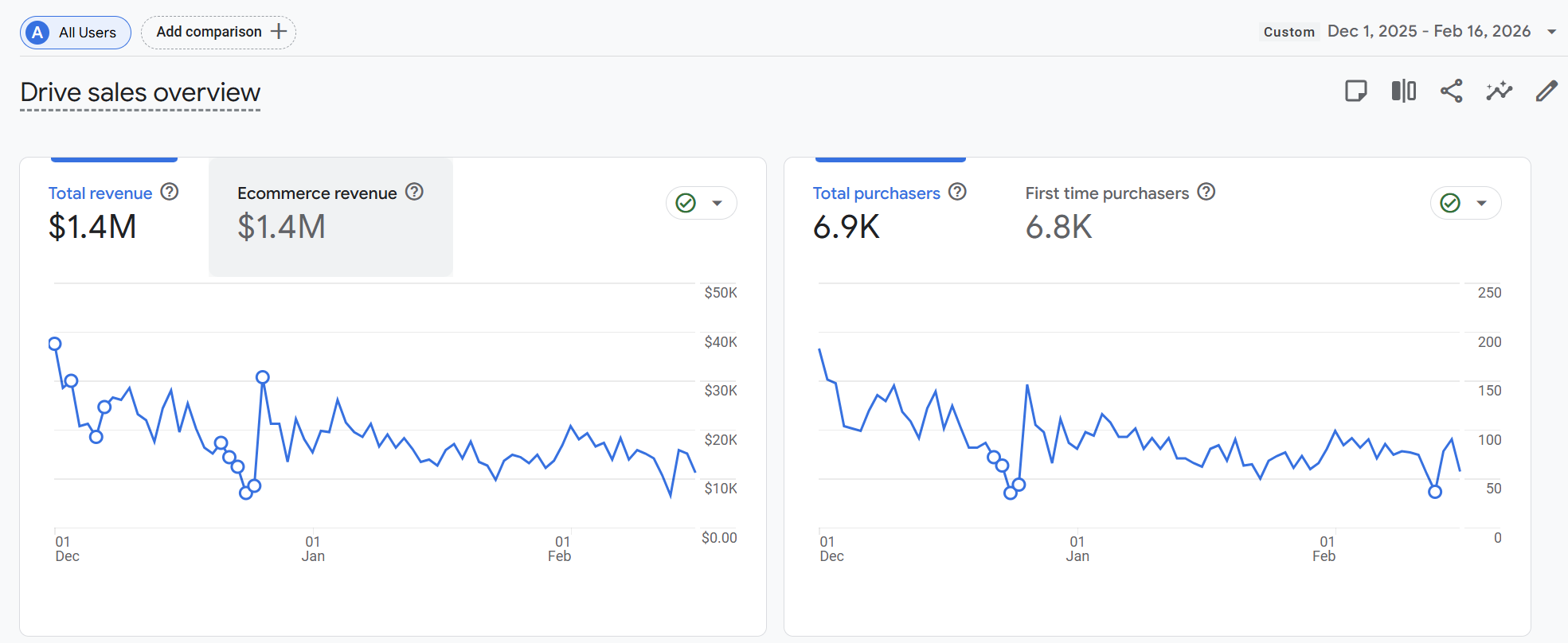
Don't build the Taj Mahal before you've validated your concept. Start with a tent, prove the model works, then upgrade.
Website Cost Estimator
Get a ballpark estimate for your project — takes 60 seconds
Hidden Website Costs Nobody Talks About
The quoted price is just the beginning. Here's what actually determines your total cost of ownership.
Ongoing Website Maintenance Costs
| Cost Type | Annual Range | What It Covers |
|---|---|---|
| Domain Name | $20 to $200 | Your website address. .com.au domains are roughly $24/year. Premium domains can cost thousands. |
| Hosting | $120 to $3,600+ | Shared: $10 to $30/mo. VPS: $50 to $150/mo. Dedicated: $200 to $500+/mo. |
| SSL Certificate | $0 to $250 | Usually included with hosting. Extended validation costs more for eCommerce. |
| Maintenance and Updates | $600 to $3,600+ | Security patches, plugin updates, backups. Skip this and you'll get hacked. |
| Content Updates | $150 to $500/hour | New pages, blog posts, product descriptions. DIY or outsource. |
The Costs of Getting Your Website Wrong
- Lost SEO from Poor Migration: Moving from an old site without proper redirects? I've seen businesses lose 60% of their organic traffic overnight. Recovery takes months and costs thousands.
- Conversion Rate Impact: A site converting at 1% instead of 3% doesn't sound like much. But with $5,000/month on ads generating 1,000 visitors, that's the difference between 10 and 30 customers. Over a year, that gap is tens of thousands in lost revenue.
- Platform Lock-In: Some builders charge monthly rental fees you can't escape. I've seen businesses locked into 48-month contracts at $200/month for a website they could have owned for $6,000.
- Technical Debt: Cheap builds use outdated code, poor structure, and plugins that break. The $2,000 saving becomes a $12,000 rebuild.
Web Designer vs Web Developer: Why You Need Both
Here's a mistake I see constantly: businesses hiring a developer who can't design, or a designer who can't code.
Developers are great with functionality. They make things work. But most have zero eye for design or user experience. They'll build you a perfectly functional website that looks like it was designed in 2008.
Designers understand aesthetics and user psychology. They know how to make visitors take action. But they can't necessarily code their vision into reality.
The difference is massive. I recently saw two quotes for the same project. One agency quoted $8,000, the other $14,000. The client went with the cheaper option because the portfolios "looked similar."
What they didn't realise: the cheap agency had their developer design the site (hence the lower quote). The expensive agency had a proper designer create the experience, then had developers build it.
Six months later, the client came back. Their site worked fine but converted terribly. They spent another $9,000 to rebuild it properly. That "saving" cost them an extra $3,000 plus six months of poor performance.
Here's an example of a professional services website where design and development worked hand-in-hand to drive results:

Pro Tip
Always work with a team that separates design and development. The best websites are designed first, then developed, not cobbled together by a developer who "knows a bit about design."
Website Cost Estimator
Get a ballpark estimate for your project — takes 60 seconds
How to Evaluate Website Quotes (Questions to Ask)
Forget the price for a minute. Here are the questions that actually matter when comparing web providers:
- "What happens to my conversion rate with this design?" If they can't talk about CTA placement, trust signals, objection handling, and user psychology, they're not thinking about results.
- "How will you maintain my existing SEO?" They should talk about content migration, redirect strategy, URI structure, and meta data preservation. If they say "we'll make it look pretty and Google will love it," run.
- "What's included in ongoing maintenance?" Security updates? Plugin management? Backups? Performance monitoring? Get this in writing.
- "How do you handle mobile users?" Over 60% of traffic is mobile. If they're not designing mobile-first, your site will haemorrhage mobile conversions.
- "What's your process for understanding my business?" Great designers start with questions, not mockups. If they start designing before understanding your business, they're guessing.
- "Can you show me sites that generate measurable results?" Portfolios full of pretty pictures mean nothing. You want case studies showing traffic growth, conversion improvements, revenue impact. Check out our case studies for examples.
Website Platform Comparison: WordPress vs Shopify vs Custom
Different platforms have vastly different cost implications.
| Platform | Build Cost | Pros | Cons | Best For |
|---|---|---|---|---|
| WordPress | $3,000 to $25,000+ | Massive plugin ecosystem, great for SEO, own your content | Requires maintenance, security responsibility | Lead gen, blogs, content-heavy sites |
| Shopify | $6,000 to $50,000+ | Hosting included, PCI compliant, excellent for eCommerce | Monthly fees ($39 to $2,000+/mo), limited customisation on lower tiers | Product-based businesses |
| Wix/Squarespace | $500 to $3,000 | Easy to use, cheap upfront | Poor SEO, limited flexibility, vendor lock-in | Absolute beginners or very basic sites |
| Custom Build | $25,000 to $200,000+ | Complete control, unique functionality | Expensive, requires specialised developers | Enterprise with specific requirements |
| AI Builders (Lovable) | $50 to $5,000 | Custom code, rapid iteration, no lock-in, advanced features | Requires strategic knowledge, design can be generic without guidance | Tech-savvy founders, startups, businesses with clear vision |
The platform doesn't determine success. Implementation does. But choosing the wrong platform can make success significantly harder.
Here's a landing page we built that drives property investment enquiries with a clear, focused conversion path:

How AI Website Builders Are Changing Everything
Something's shifting in the web development world, and it's happening faster than most agencies want to admit.
AI-powered website builders are fundamentally changing the economics of website development. And I'm not talking about the templated garbage from Wix or Squarespace with "AI features" bolted on. This is a completely different category.
Tools like Lovable let you build a fully functional, custom-coded website using nothing but text prompts. You describe what you want, the AI writes real code, and you get a working site. No templates. No drag-and-drop limitations. Actual custom React code that you own.
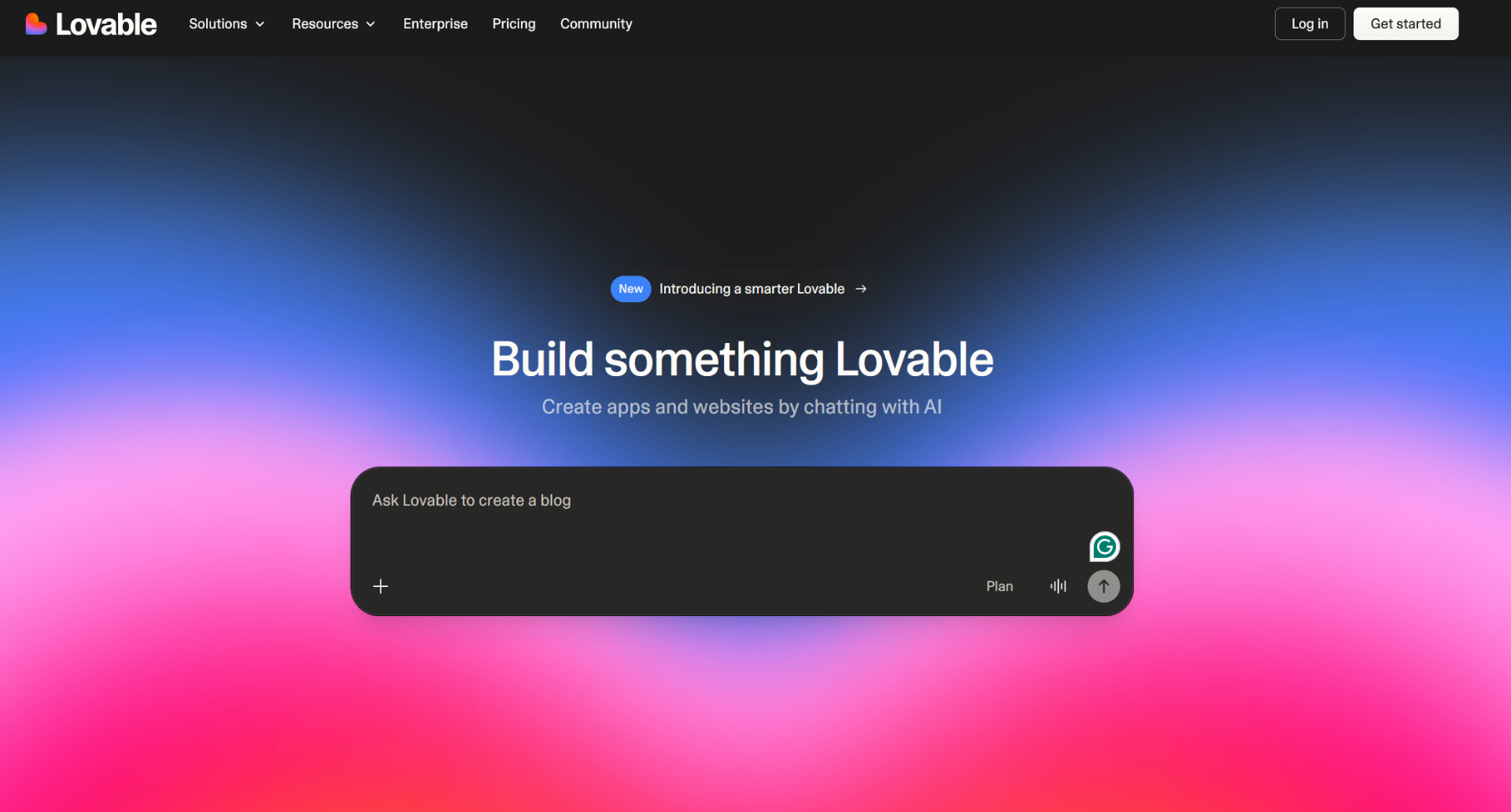
If you know how to prompt AI, or you're comfortable using ChatGPT or Claude, then you'll do just fine with a tool like Lovable. The learning curve is surprisingly gentle for anyone who's already using AI in their daily workflow.
The Massive Advantages of AI Builders
| Advantage | What It Means For Your Business |
|---|---|
| Speed | Go from idea to functional site in hours, not weeks. Your competitors will wonder how you moved so fast. |
| Cost | No designer fees, no developer fees. For roughly 1,000 credits in a tool like Lovable, you can build something seriously impressive. |
| No Platform Lock-In | The code is yours. No monthly rental fees, no 48-month contracts, no vendor dependency. |
| Advanced Functionality | Calculators, advanced form qualification, intake systems, interactive tools. Things that used to cost $10,000+ in custom development become a prompt away. |
| Rapid Iteration | Don't like something? Change the prompt and rebuild. Test 10 different approaches in the time it used to take to get one mockup approved. |
The Honest Disadvantages
Here's where it gets tricky, and this is the part most AI builder marketing won't tell you:
You need to know what you want. AI will happily build you a beautiful site that performs terribly. It'll do exactly what you ask for. The problem is, most business owners don't know what to ask for.
| Knowledge Gap | The Risk |
|---|---|
| Design | Many AI-generated designs are plain or generic out of the gate. If you don't know what good design looks like, the AI won't fully solve it for you. |
| SEO | You'll probably end up with a site that doesn't rank if you don't understand technical SEO, content structure, or keyword targeting. |
| Conversion Strategy | AI doesn't inherently know where trust signals should sit, how to handle objections, or what makes visitors take action. You need that knowledge to prompt it correctly. |
| Website Structure | If you don't understand information architecture, you'll build something that looks good but confuses visitors and kills your bounce rate. |
| Content Strategy | AI can generate content, but without a strategy behind it, you're just filling pages with words that don't rank or convert. |
The good news? You're always a prompt away from getting back on track. But you do need enough knowledge to first ask the right question.
Website Cost Estimator
Get a ballpark estimate for your project — takes 60 seconds
Who Should Use AI Builders?
AI builders make sense when:
- You have a clear vision of what you want but lack coding skills
- You're comfortable with AI tools and understand basic web principles
- You want to prototype and iterate rapidly before committing to an agency build
- You're a startup or small business where speed and cost matter more than pixel-perfect design
- You have marketing or conversion knowledge and just need the technical execution handled
You still need an agency when:
- You're in a high-value niche where conversion rate directly impacts revenue (like personal injury law)
- You need a comprehensive strategy layer: positioning, messaging, competitive differentiation
- You don't have time to learn what makes a website convert and need someone who already knows
- Your website is your primary revenue driver and you can't afford to get it wrong
Key Insight
The agencies that survive and thrive will be the ones that focus on the strategic layer while using AI to accelerate execution. Build faster, but build smarter. For businesses, this means you're not paying for code anymore. You're paying for the knowledge of what to build and why.
Why Some Websites Cost $25,000+ (Value-Based Pricing Explained)
Here's something most web agencies won't tell you: the price you pay isn't just about hours or complexity. It's about proven systems and documented results.
The Personal Injury Law Firm Example
We work with a lot of law firms, particularly personal injury firms. In this space, a single client can be worth $50,000 to $200,000+ in legal fees.
Here's the maths: if we generate 100 qualified leads per month for a PI firm and their intake team converts 20% to retained clients, that's 20 new cases. At $80,000 per case average, that's $1.6M in fees monthly.
What if the website converts at 1% instead of 3%? With the same ad spend, that's the difference between 33 leads and 100 leads. A $1.79M difference in monthly fees.
Suddenly, a $25,000 website doesn't seem expensive at all.
When You Have a Proven System
When an agency has a documented system that consistently delivers results in your niche, you're not paying for a website anymore. You're paying for access to that system.
We build websites for personal injury firms using specific design patterns, messaging frameworks, and conversion strategies tested across dozens of firms. That knowledge is worth significantly more than the code itself.
Website Cost Estimator
Get a ballpark estimate for your project — takes 60 seconds
Offshore vs Local Website Development: The True Cost
Hourly rates overseas can be $25/hour vs $150/hour locally. On paper, that's an 83% saving. In reality, it's rarely that simple.
What offshore actually costs:
- Time zone coordination adds hours to every exchange
- Communication gaps lead to constant rework
- Project management burden shifts entirely to you
- Quality control requires expertise you probably don't have
- No comeback if things go wrong
- Cultural and market understanding gaps affect UX
I'm not saying it can't work. But it works when you or someone on your team knows exactly what you need and can manage the build. For most small businesses, that expertise doesn't exist.
Website ROI Calculator: Is a More Expensive Website Worth It?
A website isn't an expense. It's an investment. Let me show you the actual maths:
| Scenario | Website Cost | Conversion Rate | Monthly Ad Spend | Visitors | Customers/Mo | Profit/Customer | Monthly Profit | Annual Profit |
|---|---|---|---|---|---|---|---|---|
| A: Cheap Website | $3,000 | 0.8% | $5,000 | 500 | 4 | $1,000 | $4,000 | $48,000 |
| B: Quality Website | $12,000 | 3.5% | $5,000 | 500 | 17.5 | $1,000 | $17,500 | $210,000 |
The "expensive" website costs $9,000 more upfront but generates $162,000 more profit annually. It pays for itself in less than three weeks.
Website Cost Estimator
Get a ballpark estimate for your project — takes 60 seconds
When a Cheap Website Actually Makes Sense
Go cheap when:
- You're testing a business concept and aren't sure it'll work
- You have zero budget and need something online immediately
- The website is purely informational with no conversion goals
- You have the skills to maintain and improve it yourself
Invest properly when:
- The website is a primary revenue driver
- You're running paid advertising to drive traffic
- You operate in a competitive market
- Customer acquisition cost directly impacts profitability
Estimate Your Website Cost
Use this interactive calculator to get a ballpark estimate for your project:
Website Cost Estimator
Get a ballpark estimate for your project in under 60 seconds
Step 1 of 4
What type of website do you need?
Frequently Asked Questions About Website Costs
How much does a basic website cost in Australia?
A basic website in Australia typically costs between $500 and $5,000. At the lower end, you're looking at DIY builders like Wix or Squarespace with template designs. At $2,000 to $5,000, you'll get a template-based build with some customisation, 5 to 8 pages, and basic SEO. These are fine for brand-new businesses testing the waters, but expect to rebuild within 12 months once you start driving serious traffic.
How much does a WordPress website cost?
A WordPress website in Australia ranges from $3,000 to $25,000+ depending on complexity. A simple brochure site with a premium theme might cost $3,000 to $6,000. A fully custom WordPress build with professional copywriting, SEO strategy, and conversion optimisation typically runs $10,000 to $20,000. Factor in ongoing costs for hosting ($10 to $50/month), maintenance ($50 to $300/month), and security updates.
How much should I pay for a small business website?
Most small businesses should budget between $5,000 and $10,000 for a website that will actually generate returns. This gets you a custom design, 8 to 12 pages, proper SEO foundations, decent UX, and a conversion-focused structure. Going below $5,000 means cutting strategy and conversion optimisation, the exact things that determine whether your site makes money or wastes it.
Is it worth paying more for a custom website?
Yes, if your website is a primary revenue driver or you're running paid ads to it. The data is clear: a $12,000 custom website converting at 3.5% generates $162,000 more annual profit than a $3,000 template site converting at 0.8%, assuming identical ad spend. The ROI case gets even stronger in high-value industries like legal services, accounting, and professional services.
How much does an eCommerce website cost in Australia?
eCommerce websites start at $6,000 for a professional Shopify setup and can exceed $100,000 for enterprise-level custom builds. The sweet spot for most retailers is $12,000 to $25,000, which gets you a custom theme, comprehensive product setup, advanced filtering, upsell functionality, and email integration. The platform (Shopify vs WooCommerce vs Magento) matters less than the quality of implementation.
What are the ongoing costs of running a website?
Ongoing costs typically include domain registration ($20 to $200/year), hosting ($120 to $3,600+/year), SSL certificates ($0 to $250/year), maintenance and updates ($600 to $3,600+/year), and content updates ($150 to $500/hour). Skipping maintenance is the most expensive mistake you can make because it leads to security breaches, broken functionality, and eventual full rebuilds.
Should I build my website myself or hire a professional?
Build it yourself if you're testing a concept, have zero budget, or the site is purely informational. Hire a professional if the website needs to generate leads or sales, you're running Google Ads or Facebook Ads, or you operate in a competitive market. The cost of a poor-performing website in lost conversions and wasted ad spend almost always exceeds the cost of doing it properly from the start.
Can I use AI to build my website instead of hiring a developer?
Yes, and it's becoming a viable option for many businesses. AI website builders like Lovable let you build custom-coded websites using text prompts, no design or development skills required. For roughly $50 to $100 in credits, you can build a fully functional site with advanced features like calculators, qualification forms, and interactive tools. The catch is you still need to understand what makes a website convert, rank in search engines, and drive results. AI is a powerful execution tool, but it doesn't replace strategic knowledge. If you know what good looks like, AI can get you there 10x faster and cheaper.
How long does it take to build a website?
Timelines vary based on complexity. A basic template site can be ready in 2 to 4 weeks. A standard custom website takes 4 to 8 weeks. Premium builds with extensive research, custom copywriting, and advanced features run 6 to 12 weeks. Enterprise projects with complex integrations typically take 10 to 16 weeks. Be wary of anyone promising a custom site in under two weeks, as they're almost certainly cutting corners on strategy and testing.
The Bottom Line on Website Costs
You don't get to choose what a website costs. The market, the scope, the required expertise: these determine the investment needed.
What you do get to choose is whether you want a website that generates revenue or one that burns money.
Most businesses try to minimise cost and end up maximising waste. They spend $3,000 on a website, then $30,000 on ads driving traffic to something that doesn't convert. The website was the expensive part.
Here's what you should actually do:
- Get 3 to 5 quotes from reputable agencies or professionals. Don't just compare price, compare what you're actually getting. Ask the tough questions about conversion optimisation, SEO strategy, ongoing support.
- Look for proof of results, not just pretty portfolios. Anyone can make a site look good. You need someone who can make a site perform. Check out what we've done for our clients.
- Factor in the ongoing costs: hosting, maintenance, updates, content. A site with no maintenance will fail.
- Most importantly, think about ROI, not cost. If a $15,000 website generates an extra $100,000 in revenue annually compared to a $5,000 one, which website was actually expensive?
If you're ready to build a website that actually generates revenue instead of wasting it, let's talk. I'll give you a straight assessment of what you need, what it'll cost, and what you can realistically expect in return. No hard selling, just honest advice.
Want us to implement these strategies for you?
Book a free strategy call and let's discuss how we can grow your business.
Book Your Free Call
Written by
Byron Trzeciak
Founder of PixelRush, Byron has spent over a decade mastering digital marketing. His agency has helped 300+ brands grow, managed $10M+ in ad spend, and optimised 400+ landing pages. He shares hard-won strategies so you can skip the learning curve.
Continue Reading
View All →
Why Personal Injury Google Ads Are Getting More Expensive (And What to Do About It)
22 min read
The Lead Response Crisis: Why Your "Bad Leads" Might Actually Be Gold
4 min read